When deadlines start slipping, most accounting firms assume they have a staffing problem.
The immediate response is often to recruit more people. However, many UK accounting firms discover that even after hiring, delivery pressures remain, review backlogs continue, and turnaround times fail to improve.
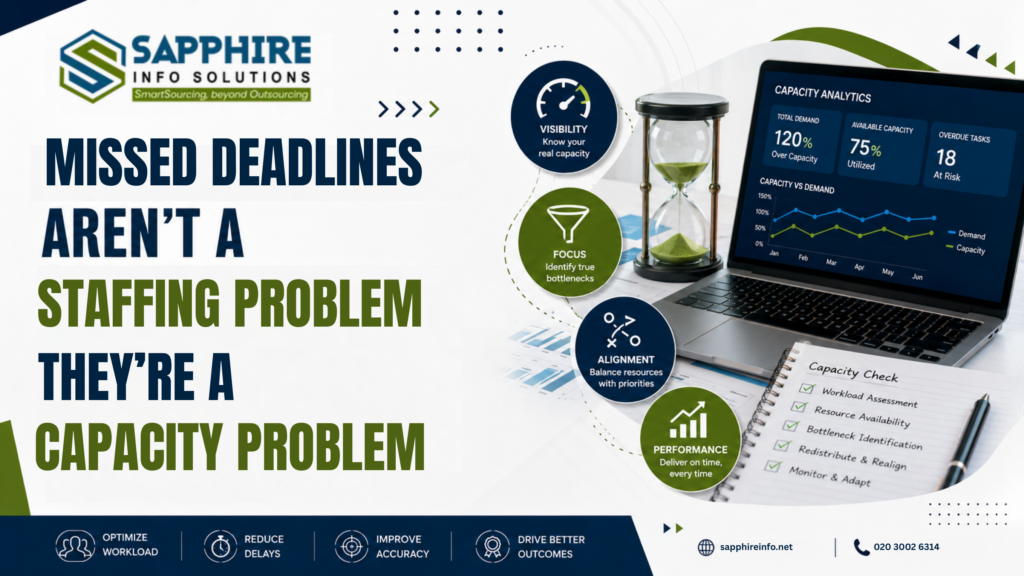
In many cases, the real issue is not staffing—it is capacity.
This article explores why capacity constraints are becoming a bigger challenge than recruitment and how outsourced accounting support helps firms maintain service levels without constantly expanding headcount.
Why Capacity Is Different From Headcount
Many firms measure resources by the number of people they employ.
However, capacity is influenced by several factors:
- Workflow efficiency
- Skill distribution
- Technology usage
- Quality control processes
- Seasonal demand fluctuations
A firm may have sufficient staff but still struggle with deadlines if work is not flowing efficiently.
This is particularly common during VAT deadlines, year-end accounts preparation, payroll processing periods, and tax seasons.
The Signs of a Capacity Problem
Many firms experiencing capacity issues notice:
Growing Review Backlogs
Partners and managers spend increasing amounts of time reviewing work rather than advising clients.
Rework and Corrections
Errors identified late in the process create additional work and delay delivery.
Missed Internal Deadlines
Preparation stages take longer, leaving less time for quality reviews.
Staff Burnout
Teams work longer hours during peak periods, increasing stress and reducing productivity.
These symptoms often persist even after new hires join the firm.
Why Hiring Doesn’t Always Solve Delivery Challenges
Recruitment remains important, but it is becoming increasingly expensive and difficult.
New employees require:
- Recruitment costs
- Training time
- Management oversight
- Ongoing employment expenses
Additionally, workload demand is rarely consistent throughout the year.
Many firms need additional support during peak periods rather than permanent year-round capacity.
This makes outsourcing a flexible alternative.
How Outsourced Accounting Services Increase Capacity
Outsourcing allows firms to access experienced accounting professionals without increasing fixed overhead.
Services commonly outsourced include:
- Bookkeeping
- VAT Returns
- Payroll Processing
- Management Accounts
- Year-End Accounts
- Personal Tax Returns
- Corporation Tax Returns
By delegating production work, firms can improve turnaround times and reduce internal bottlenecks.
The Role of Technology and AI
Modern accounting firms increasingly use:
- Xero
- QuickBooks
- Sage
These systems improve efficiency, but software alone does not solve capacity issues.
The most successful firms combine technology with outsourced support.
Sapphire Info Solutions supports UK accounting firms through outsourced accounting services enhanced by AI-enabled workflows via Sapphire Hub, helping firms improve visibility, consistency, and delivery quality.
What This Means for Your Practice
Firms that address capacity rather than simply increasing headcount are better positioned to:
✔ Meet deadlines consistently
✔ Reduce partner workload
✔ Improve turnaround times
✔ Protect staff wellbeing
✔ Scale more efficiently
Conclusion
Missed deadlines are often a symptom of capacity constraints rather than staffing shortages.
By improving workflows, leveraging technology, and using outsourced accounting support strategically, UK accounting firms can build flexible capacity without increasing operational pressure.
Sapphire Info Solutions helps firms achieve this through outsourced bookkeeping, VAT, payroll, management accounts, tax, and year-end accounting support delivered as a seamless extension of their team.