Year-end accounts are one of the most demanding parts of the accounting cycle for UK firms.
As client numbers grow and compliance requirements increase, many practices struggle to keep year-end work accurate, consistent, and on time.
The challenge is not just volume—it’s review readiness.
When year-end accounts arrive incomplete or inconsistent, partners and managers spend valuable time fixing issues instead of reviewing and signing off.
This blog outlines a practical, review-ready checklist that UK accounting firms use to scale year-end accounts preparation effectively—and explains how outsourced back-office support helps make this process sustainable.
Why Year-End Accounts Become a Bottleneck as Firms Grow
As firms scale, year-end pressure increases due to:
- Large volumes of accounts landing at the same time
- Bookkeeping backlogs carried forward from earlier periods
- Inconsistent working papers across clients
- Tight statutory deadlines
- Limited senior review capacity
Without a structured approach, year-end accounts quickly become a firm-wide stress point.
What “Review-Ready” Really Means for Year-End Accounts
Review-ready accounts are not just completed accounts.
They are accounts that:
- Require minimal correction
- Have clear supporting schedules
- Include documented assumptions
- Are easy to review and sign off
- Stand up to audit or HMRC scrutiny
Achieving this consistently requires process, not heroics.
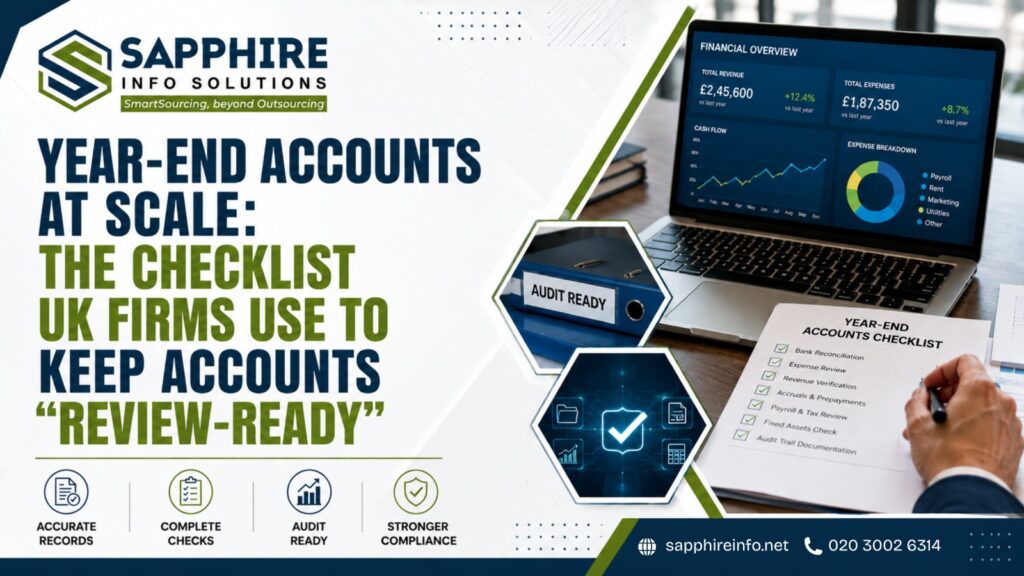
The Review-Ready Year-End Accounts Checklist
1. Clean, Up-to-Date Bookkeeping
Everything starts with bookkeeping.
Before year-end work begins:
- All transactions should be posted
- Bank and control accounts reconciled
- Suspense and clearing accounts resolved
Outsourced bookkeeping support helps ensure year-end preparation starts from accurate data, not clean-up work.
Sapphire Info Solutions supports UK firms with bookkeeping workflows that reduce year-end corrections.
2. VAT Reconciliations Completed and Agreed
Unreconciled VAT is a common source of last-minute issues.
A review-ready checklist includes:
- VAT control reconciled to submissions
- Differences explained and documented
- Supporting VAT reports attached
This prevents late adjustments during year-end review.
3. Clear Lead Schedules and Working Papers
Every material balance should be supported by:
- Clear lead schedules
- Cross-referenced working papers
- Prior-year comparisons where relevant
Consistent working papers significantly reduce review time.
Outsourced year-end preparation teams deliver standardised schedules aligned to firm templates.
4. Management Accounts Alignment
Where management accounts exist, year-end figures should:
- Reconcile to the final ledger
- Have movements explained
- Highlight unusual variances
This alignment reduces review queries and improves confidence in the final numbers.
5. Tax Adjustments Identified Early
Late tax adjustments are a major cause of rework.
A strong checklist ensures:
- Capital allowances reviewed
- Accruals and provisions assessed
- Director transactions analysed
- Deferred tax considered where applicable
Outsourced tax return preparation helps identify and document these items earlier in the process.
6. Payroll and Employment Costs Reconciled
Payroll errors often surface at year end.
Review-ready accounts include:
- Payroll control reconciled
- RTI figures agreed
- Employment costs analysed
Outsourced payroll support ensures employment data flows accurately into year-end accounts.
7. Audit Trails and Supporting Documentation in Place
Whether accounts are audited or not, documentation matters.
A checklist should confirm:
- Key assumptions are documented
- Supporting evidence is attached
- Adjustments are clearly logged
This protects firms during audits, HMRC reviews, and client queries.
Sapphire Info Solutions supports audit-ready documentation as part of its outsourced audit support services.
How This Checklist Reduces Review Time
When year-end accounts follow a consistent checklist:
- Review becomes exception-based
- Senior staff focus on judgement, not corrections
- Sign-off is faster and less stressful
- Billing can happen sooner
This is essential for firms managing large year-end volumes.
Why Outsourced Back-Office Support Makes Scaling Possible
Internal teams often struggle to maintain checklist discipline during peak periods.
Outsourced back-office support helps by:
- Providing additional preparation capacity
- Following standardised processes
- Delivering review-ready outputs
- Reducing dependency on individual staff
- Absorbing year-end volume spikes
Sapphire Info Solutions works as a white-label outsourced accounting partner, supporting UK firms with year-end accounts preparation alongside bookkeeping and VAT, tax returns, management accounts, payroll, and audit support.
Common Mistakes That Break Review Readiness
UK accounting firms should avoid:
- Starting year-end work with incomplete bookkeeping
- Relying on informal working papers
- Leaving tax considerations until the end
- Overloading senior reviewers
- Treating year-end as a once-a-year event
Review readiness is built throughout the year, not at the deadline.
A Scalable Model for Year-End Success
Firms that scale year-end accounts successfully:
- Use clear preparation checklists
- Standardise documentation
- Separate preparation from review
- Use outsourced support strategically
- Protect partner and manager time
This approach improves quality, turnaround, and profitability.
Final Thoughts
Year-end accounts don’t have to be chaotic.
With a clear, practical checklist and the right support structure, UK accounting firms can deliver review-ready accounts at scale—without burning out teams or compromising quality.
Sapphire Info Solutions supports UK accounting firms with reliable, white-label outsourced accounting and back-office services, helping firms keep year-end accounts accurate, compliant, and review-ready—no matter the volume.