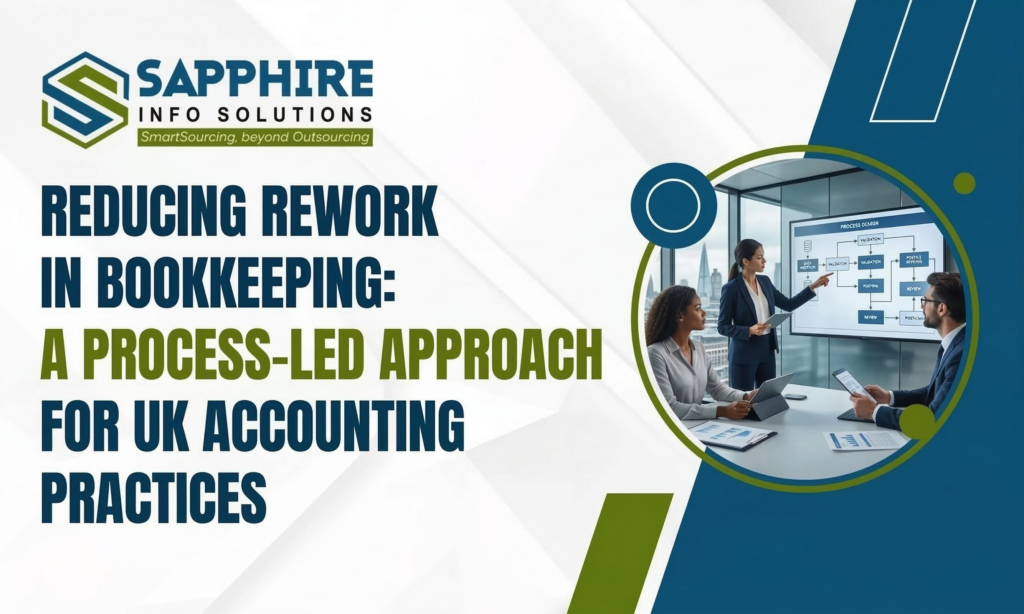
Reducing Rework in Bookkeeping: A Process-Led Approach for UK Accounting Practices

Reducing Rework in Bookkeeping: A Process-Led Approach for UK Accounting Practices

Rework in bookkeeping is one of the biggest hidden drains on UK accounting firms.
It consumes senior time, delays downstream work, and quietly reduces profitability.

Most firms don’t suffer from a lack of effort.
They suffer from inconsistent processes, overloaded teams, and unclear standards.

This blog explains how UK accounting practices can reduce rework in bookkeeping using a process-led approach, and how outsourced back-office support can help make that improvement sustainable.


Why Rework in Bookkeeping Is Such a Big Problem

Bookkeeping is the foundation for:

  • VAT returns
  • Management accounts
  • Tax returns
  • Year-end accounts
  • Audit support

When bookkeeping is inconsistent or incomplete, every service that follows slows down.

Common rework triggers include:

  • Incomplete or late source data
  • Inconsistent coding and reconciliations
  • Missing schedules or explanations
  • Rushed work during peak periods
  • Multiple people working without standardised processes

The result is more checking, more corrections, and longer turnaround times.


Why Rework Costs More Than You Think

Rework doesn’t just affect bookkeeping teams.

It creates:

  • Delays in VAT filings and compliance work
  • Bottlenecks in management accounts and reporting
  • Extra pressure during year-end accounts preparation
  • Increased review time for managers and partners
  • Slower billing and reduced realisation

Over time, this erodes margins and limits a firm’s ability to scale.


A Process-Led Approach to Reducing Bookkeeping Rework

The most effective firms don’t fix rework by “checking harder”.
They fix it by improving the process upstream.Step 1: Standardise Inputs Before Work Starts


Step 1: Standardise Inputs Before Work Starts

Most bookkeeping errors begin before the first entry is posted.

Best practices include

  • Clear client data submission checklists
  • Agreed chart of accounts and coding rules
  • Defined cut-off dates for month-end and VAT periods
  • Consistent use of software such as Xero, QuickBooks, or Sage

Clean, consistent inputs reduce downstream corrections dramatically.


Step 2: Define What “Complete Bookkeeping” Looks Like

Many firms assume everyone knows what “done” means.
In reality, expectations often differ.

A review-ready bookkeeping file should include:

  • Bank and control account reconciliations
  • Clear supporting schedules
  • VAT-ready coding and documentation
  • Notes explaining unusual or one-off transactions

Sapphire Info Solutions supports UK firms by delivering bookkeeping to clearly defined, review-ready standards rather than partial outputs.


Step 3: Separate Bookkeeping From Review and Advisory

Rework increases when the same person:

  • Prepares
  • Reviews
  • Fixes
  • Explains

A better structure separates:

  • Preparation: clean, consistent bookkeeping
  • Review: focused on exceptions and risk areas
  • Advisory: interpretation and client discussion

Outsourced back-office bookkeeping allows internal teams to maintain this separation without increasing headcount.


Step 4: Build Reconciliation and Exception Checks Into the Process

Errors often go unnoticed until late review stages.

Process-led firms:

  • Reconcile key balances monthly
  • Use exception-based checks
  • Flag unusual movements early

This reduces rework during VAT, management accounts, and year-end stages.


Step 5: Create Feedback Loops to Prevent Repeat Errors

Rework often repeats because feedback isn’t captured.

Effective practices:

  • Log common errors
  • Update checklists and templates
  • Share feedback with preparers regularly

Over time, this improves accuracy and reduces review effort.

Sapphire Info Solutions works with UK accounting firms to embed feedback into back-office workflows, improving quality month after month.


How Reduced Bookkeeping Rework Improves Other Services

VAT Returns

Cleaner bookkeeping means:

  • Faster VAT preparation
  • Fewer HMRC queries
  • Lower compliance risk

Management Accounts

Consistent data allows:

  • Timely monthly or quarterly reporting
  • Better variance analysis
  • More meaningful client conversations

Year-End Accounts

Accurate ledgers reduce:

  • Late adjustments
  • Sign-off delays
  • Stress during busy season

Payroll and Audit Support

Reliable bookkeeping ensures:

  • Accurate payroll reconciliations
  • Cleaner audit trails
  • Faster audit support delivery

The Role of Outsourced Back-Office Support

Reducing rework requires consistency—something overstretched internal teams struggle to maintain.

Outsourced back-office support helps by:

  • Providing dedicated bookkeeping capacity
  • Following standardised processes
  • Delivering review-ready work
  • Reducing dependency on individual staff members

Sapphire Info Solutions supports UK accounting firms with outsourced bookkeeping, VAT, tax returns, management accounts, year-end accounts, payroll, and audit support—operating as a white-label extension of the firm.


Why Process Beats Effort Every Time

Rework is not a people problem.
It’s a process problem.

Firms that reduce rework successfully:

  • Invest in standardisation
  • Separate preparation from review
  • Use outsourced support strategically
  • Protect senior time for high-value work

The result is faster turnaround, higher margins, and a more scalable practice.


Final Thoughts

If your firm is spending too much time fixing bookkeeping errors, the solution is not more checking or longer hours.

A process-led approach, supported by reliable outsourced back-office accounting, can significantly reduce rework while improving quality and compliance.

Sapphire Info Solutions works alongside UK accounting firms to help stabilise bookkeeping workflows, reduce rework, and support sustainable growth—without disrupting client relationships.

Book Your Free Consultation Today!

Simplify your accounting processes with expert outsourcing solutions. Schedule a free consultation with us to discuss your needs.

Don’t wait—take the first step toward hassle-free accounting!

Rework in bookkeeping is one of the biggest hidden drains on UK accounting firms.
It consumes senior time, delays downstream work, and quietly reduces profitability.

Most firms don’t suffer from a lack of effort.
They suffer from inconsistent processes, overloaded teams, and unclear standards.

This blog explains how UK accounting practices can reduce rework in bookkeeping using a process-led approach, and how outsourced back-office support can help make that improvement sustainable.


Why Rework in Bookkeeping Is Such a Big Problem

Bookkeeping is the foundation for:

  • VAT returns
  • Management accounts
  • Tax returns
  • Year-end accounts
  • Audit support

When bookkeeping is inconsistent or incomplete, every service that follows slows down.

Common rework triggers include:

  • Incomplete or late source data
  • Inconsistent coding and reconciliations
  • Missing schedules or explanations
  • Rushed work during peak periods
  • Multiple people working without standardised processes

The result is more checking, more corrections, and longer turnaround times.


Why Rework Costs More Than You Think

Rework doesn’t just affect bookkeeping teams.

It creates:

  • Delays in VAT filings and compliance work
  • Bottlenecks in management accounts and reporting
  • Extra pressure during year-end accounts preparation
  • Increased review time for managers and partners
  • Slower billing and reduced realisation

Over time, this erodes margins and limits a firm’s ability to scale.


A Process-Led Approach to Reducing Bookkeeping Rework

The most effective firms don’t fix rework by “checking harder”.
They fix it by improving the process upstream.Step 1: Standardise Inputs Before Work Starts


Step 1: Standardise Inputs Before Work Starts

Most bookkeeping errors begin before the first entry is posted.

Best practices include

  • Clear client data submission checklists
  • Agreed chart of accounts and coding rules
  • Defined cut-off dates for month-end and VAT periods
  • Consistent use of software such as Xero, QuickBooks, or Sage

Clean, consistent inputs reduce downstream corrections dramatically.


Step 2: Define What “Complete Bookkeeping” Looks Like

Many firms assume everyone knows what “done” means.
In reality, expectations often differ.

A review-ready bookkeeping file should include:

  • Bank and control account reconciliations
  • Clear supporting schedules
  • VAT-ready coding and documentation
  • Notes explaining unusual or one-off transactions

Sapphire Info Solutions supports UK firms by delivering bookkeeping to clearly defined, review-ready standards rather than partial outputs.


Step 3: Separate Bookkeeping From Review and Advisory

Rework increases when the same person:

  • Prepares
  • Reviews
  • Fixes
  • Explains

A better structure separates:

  • Preparation: clean, consistent bookkeeping
  • Review: focused on exceptions and risk areas
  • Advisory: interpretation and client discussion

Outsourced back-office bookkeeping allows internal teams to maintain this separation without increasing headcount.


Step 4: Build Reconciliation and Exception Checks Into the Process

Errors often go unnoticed until late review stages.

Process-led firms:

  • Reconcile key balances monthly
  • Use exception-based checks
  • Flag unusual movements early

This reduces rework during VAT, management accounts, and year-end stages.


Step 5: Create Feedback Loops to Prevent Repeat Errors

Rework often repeats because feedback isn’t captured.

Effective practices:

  • Log common errors
  • Update checklists and templates
  • Share feedback with preparers regularly

Over time, this improves accuracy and reduces review effort.

Sapphire Info Solutions works with UK accounting firms to embed feedback into back-office workflows, improving quality month after month.


How Reduced Bookkeeping Rework Improves Other Services

VAT Returns

Cleaner bookkeeping means:

  • Faster VAT preparation
  • Fewer HMRC queries
  • Lower compliance risk

Management Accounts

Consistent data allows:

  • Timely monthly or quarterly reporting
  • Better variance analysis
  • More meaningful client conversations

Year-End Accounts

Accurate ledgers reduce:

  • Late adjustments
  • Sign-off delays
  • Stress during busy season

Payroll and Audit Support

Reliable bookkeeping ensures:

  • Accurate payroll reconciliations
  • Cleaner audit trails
  • Faster audit support delivery

The Role of Outsourced Back-Office Support

Reducing rework requires consistency—something overstretched internal teams struggle to maintain.

Outsourced back-office support helps by:

  • Providing dedicated bookkeeping capacity
  • Following standardised processes
  • Delivering review-ready work
  • Reducing dependency on individual staff members

Sapphire Info Solutions supports UK accounting firms with outsourced bookkeeping, VAT, tax returns, management accounts, year-end accounts, payroll, and audit support—operating as a white-label extension of the firm.


Why Process Beats Effort Every Time

Rework is not a people problem.
It’s a process problem.

Firms that reduce rework successfully:

  • Invest in standardisation
  • Separate preparation from review
  • Use outsourced support strategically
  • Protect senior time for high-value work

The result is faster turnaround, higher margins, and a more scalable practice.


Final Thoughts

If your firm is spending too much time fixing bookkeeping errors, the solution is not more checking or longer hours.

A process-led approach, supported by reliable outsourced back-office accounting, can significantly reduce rework while improving quality and compliance.

Sapphire Info Solutions works alongside UK accounting firms to help stabilise bookkeeping workflows, reduce rework, and support sustainable growth—without disrupting client relationships.

The Essential Guide to Outsourced Accounting
for UK Accounting Firms
The Essential Guide to Outsourced Accounting
for UK Accounting Firms
Influencing Outsourcing for Accounting Practices
A guide examining the alternatives for Outsourcing and in-house operations
5 Key Factors
Influencing Outsourcing for Accounting Practices
5 Key Factors
A guide examining the alternatives for Outsourcing and in-house operations
Guide For Small Accounting Firms In The UK
Cybersecurity
Guide For Small Accounting Firms In The UK
Cybersecurity
Sapphire Guide To AI For Accountants
AI Fundamentals
Sapphire Guide To AI For Accountants
AI Fundamentals
Open book icon ×