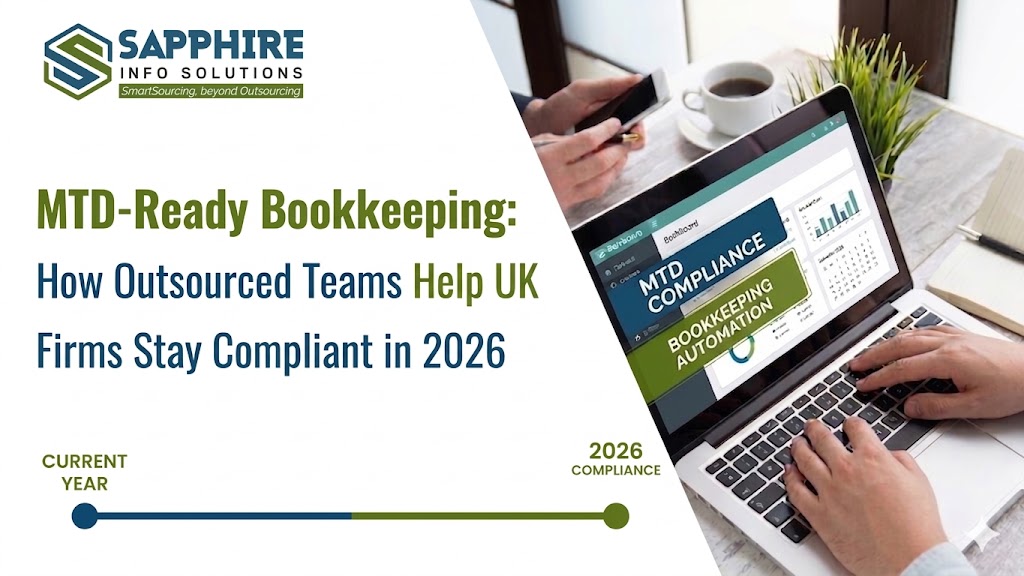
Making Tax Digital (MTD) is no longer a future concept for UK accounting firms.
With MTD for Income Tax Self Assessment (ITSA) expanding from 2026, firms must now operate with continuous, digital-first bookkeeping rather than annual clean-ups.
For many practices, the challenge is not understanding MTD rules—but ensuring bookkeeping is accurate, timely, and submission-ready every quarter.
This blog explains what MTD-ready bookkeeping really means, why many firms struggle to deliver it in-house, and how outsourced back-office teams can help UK firms stay compliant without overloading staff.
Why 2026 Changes the Bookkeeping Model for UK Firms
Under MTD for ITSA, HMRC expects:
- Digital records to be maintained throughout the year
- Quarterly submissions based on up-to-date data
- Fewer year-end corrections and adjustments
This fundamentally changes how bookkeeping must be delivered.
Annual or irregular bookkeeping is no longer sufficient.
MTD requires ongoing accuracy, consistency, and discipline—across hundreds of clients.
Common Bookkeeping Challenges Under MTD
Many UK accounting firms face the same issues when preparing for MTD:
- Bookkeeping completed too late for quarterly submissions
- Inconsistent coding and reconciliations
- Data quality issues only discovered at VAT or year-end stage
- Limited internal capacity for frequent reviews
- Senior staff pulled into routine corrections
Without structural changes, MTD quickly becomes a constant pressure cycle rather than a predictable process.
What Does “MTD-Ready Bookkeeping” Actually Mean?
MTD-ready bookkeeping is not just digital bookkeeping.
It means:
- Transactions recorded promptly and consistently
- Bank and control accounts reconciled regularly
- VAT-ready data maintained throughout the year
- Clear audit trails and digital records
- Minimal adjustments required at quarter-end and year-end
In short, bookkeeping must be review-ready at any point in the year.
Why In-House Teams Struggle to Stay MTD-Ready
Even well-run firms find MTD bookkeeping challenging because:
- Quarterly deadlines clash with VAT, payroll, and year-end work
- Recruitment shortages limit processing capacity
- Bookkeeping is often deprioritised behind urgent compliance tasks
- Review workloads increase significantly under MTD
As a result, firms risk falling behind—despite best efforts.
This is where outsourced back-office support becomes a practical solution.
How Outsourced Teams Support MTD-Ready Bookkeeping
1. Consistent, Ongoing Bookkeeping Cycles
Outsourced bookkeeping teams work to fixed schedules rather than last-minute deadlines.
This ensures:
- Records are kept current throughout the year
- Quarterly MTD submissions are easier to prepare
- Errors are identified early rather than at submission stage
Sapphire Info Solutions supports UK accounting firms with structured bookkeeping workflows designed specifically for MTD compliance.
2. Standardised Processes That Improve Accuracy
MTD struggles in inconsistent environments.
Outsourced teams follow:
- Defined coding rules
- Standard reconciliation procedures
- Consistent documentation practices
This reduces variation across clients and improves data quality.
3. Cleaner VAT and Quarterly Submissions
MTD-ready bookkeeping directly improves VAT and quarterly reporting.
Benefits include:
- Faster VAT return preparation
- Fewer HMRC queries
- Reduced corrections at quarter-end
Outsourced bookkeeping and VAT services help firms maintain compliance confidence across multiple reporting cycles.
4. Reduced Pressure on Senior Staff
Under MTD, frequent reviews can overwhelm managers and partners.
Outsourced teams help by:
- Delivering review-ready bookkeeping
- Reducing rework and corrections
- Allowing senior staff to focus on oversight and advisory
This makes quarterly reporting sustainable rather than exhausting.
How MTD-Ready Bookkeeping Improves Other Core Services
Tax Returns
Clean, current bookkeeping reduces:
- Late tax return adjustments
- Missing data issues
- End-of-period pressure
Management Accounts
Regular bookkeeping supports:
- Timely management reporting
- Better variance analysis
- More meaningful client conversations
Year-End Accounts
When bookkeeping is MTD-ready:
- Year-end work is faster
- Fewer surprises arise
- Audit trails are cleaner
Payroll and Audit Support
Accurate records improve:
- Payroll reconciliations
- Audit preparation and evidence gathering
- Overall compliance confidence
Sapphire Info Solutions supports all these services through integrated outsourced back-office delivery.
Why Outsourced Back-Office Support Makes MTD Scalable
MTD for ITSA turns compliance into a year-round operational requirement.
Outsourced back-office support helps firms by:
- Providing consistent processing capacity
- Reducing dependency on individual staff
- Supporting standardised workflows
- Maintaining compliance discipline across quarters
- Improving turnaround and profitability
Sapphire Info Solutions works as a white-label outsourced accounting partner, supporting UK firms with bookkeeping, VAT, tax returns, management accounts, year-end accounts, payroll, and audit support—aligned to MTD requirements.
Avoiding Common MTD Bookkeeping Mistakes
To stay compliant in 2026, firms should avoid:
- Treating MTD as an annual exercise
- Relying on last-minute clean-ups
- Allowing inconsistent bookkeeping practices
- Overloading internal teams without support
MTD-ready bookkeeping requires process, capacity, and consistency.
Final Thoughts
MTD for Income Tax is not just a reporting change—it is a shift in how bookkeeping must be delivered.
UK accounting firms that succeed in 2026 will:
- Build MTD-ready bookkeeping workflows
- Align VAT, tax, and reporting processes
- Use outsourced back-office teams strategically
- Protect internal teams from continuous pressure
With the right structure and support, MTD compliance becomes predictable rather than disruptive.
Sapphire Info Solutions supports UK accounting firms with reliable, MTD-ready outsourced bookkeeping and back-office services—helping firms stay compliant, accurate, and scalable as regulations evolve.